Upstream overprovisioning is coming to nbn’s network

Earlier this year, nbn announced plans to introduce upstream overprovisioning to their network. Now, that change is about to take effect.
You might be wondering “What’s overprovisioning and what’s it got to do with my internet?” Here’s the rundown on how overprovisioning works and how the upcoming changes could impact your internet.
What is overprovisioning?
Overprovisioning, also referred to as Overhead Allowance (OA), generally means your internet service is configured with slightly more capacity than the advertised speed of your plan. For example, an nbn 100 Mbps plan might be provisioned to allow around 110 Mbps. This gives the provider some headroom to account for network and protocol overheads, making it easier for you to consistently achieve the advertised speed of your plan.
What’s actually changing?
Since 2020, nbn has overprovisioned the downstream (download) data of all services except 1000 Mbps plans.
As of Sunday 18 October 2026, nbn will begin overprovisioning upstream (upload) data on all fixed line access technologies.
How much will each technology type be overprovisioned?
Customers on Fibre to the Premises (FTTP), Hybrid Fibre Coaxial (HFC), Fixed Wireless (FW) and most Fibre to the Curb (FTTC) services will have up to 15% upstream OA available.
Those on Fibre to the Node (FTTN), Fibre to the Building (FTTB), and certain FTTC profiles will receive a smaller allowance to maintain network stability.
What impact will this change have?
This change gives eligible services more upload capacity to account for network overhead, which can help customers achieve upload speeds closer to the advertised maximum of their plan.
The table below outlines the OA each technology type can expect.
| Technology | Speed | Upstream OA | Speed + OA |
| FTTN/B | 25/10 Mbps | 4% | Up to 10.4 Mbps |
| FTTN/B | 50/20 Mbps | 4% | Up to 20.8 Mbps |
| FTTN/B | 100/20 Mbps | 4% | Up to 20.8 Mbps |
| FTTN/B | 100/40 Mbps | 4% | Up to 41.6 Mbps |
| FTTC | 100/20 Mbps | 15% | Up to 23 Mbps |
| FTTC | 100/40 Mbps | 7% | Up to 42.8 Mbps |
| FTTP + FTTC + HFC | 25/10 Mbps | 15% | Up to 11.5 Mbps |
| FTTP + FTTC + HFC | 50/20 Mbps | 15% | Up to 23 Mbps |
| FTTP + HFC | 100/40 Mbps | 15% | Up to 46 Mbps |
| FTTP + HFC | 250/100 Mbps | 15% | Up to 115 Mbps |
| FTTP + HFC | 500/50 Mbps | 15% | Up to 57.5 Mbps |
| FTTP + HFC | 750/50 Mbps | 15% | Up to 57.5 Mbps |
| HFC | 2000/100 Mbps | 15% | Up to 115 Mbps |
| FTTP | 2000/200 Mbps | 15% | Up to 230 Mbps |
| FTTP | 2000/500 Mbps | 15% | Up to 575 Mbps |
| FW | 100/20 Mbps | 50% | Up to 30 Mbps |
| FW | 200-250/8-20 Mbps | 50% | Up to 30 Mbps |
| FW | 400/10-40 Mbps | 50% | Up to 60 Mbps |
Where to find your nbn technology type?
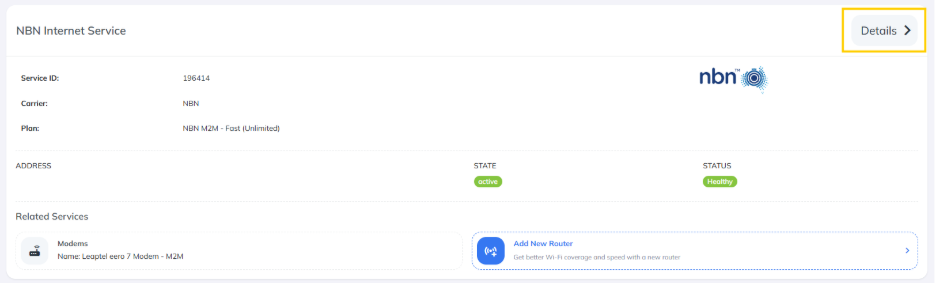
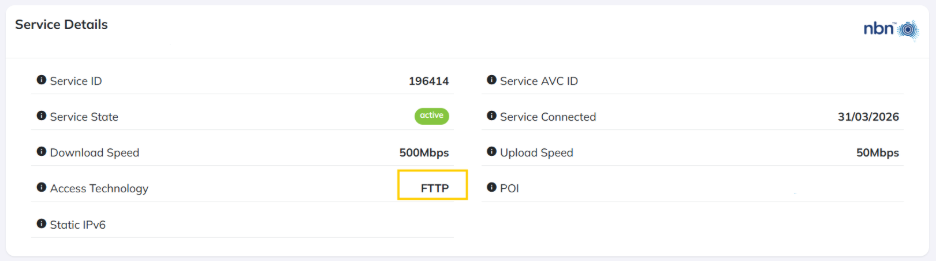
You can find your nbn technology type in your Members Portal by selecting Details and checking the Access Technology.